
introNetworks
We showed the people in a room who they should meet, and why.For more than a decade, introNetworks built private communities around one idea: the most valuable person in the room is usually someone you haven't met yet. Our software found them for you.
The company is closed now. This page is the record of what it was.
The Problem
A thousand remarkable people. Four days. Now what?Every conference has the same flaw
The room is full of people worth knowing, and you will meet almost none of them.You talk to whoever is next to you in the coffee line. You leave with a stack of cards and no idea who you missed.
Directories don't fix it. A list of a thousand names is still a thousand names.
TED 2003
Built in eight weeks.The first introNetwork was built for the 2003 TED Conference. I had been going to TED for years, and it was the clearest example of the problem I knew: an invitation-only room of extraordinary people, and no good way to find the right ones.
It started as a Macromedia sponsorship. Peter Goldie, Macromedia's VP of marketing and a friend, got the concept in front of TED, and TED said yes eight weeks before the conference. A team pulled from several states built it in that window, working out of Macromedia's San Francisco headquarters.
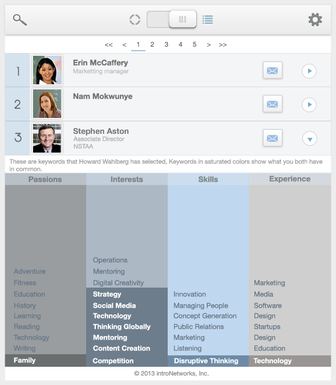
TED had a new curator that year, Chris Anderson, and his thinking about what makes a conversation last shaped how I approached the profile. Shared interests start a connection. Shared values keep it going. So we didn't stop at skills and experience. The first introNetwork asked people for their passions and their values, and matched on those too.
Our goal had been 30 percent. Sony, Polaroid and the United Way placed orders before the conference ended. A week later, Forbes.com and NYTimes.com ran pieces on TED that mentioned the attendee software nobody had seen before. That week turned a demo into a company.
How It Worked
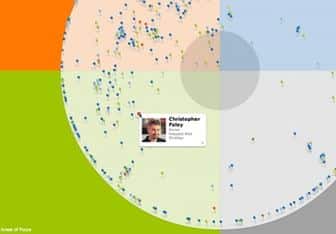
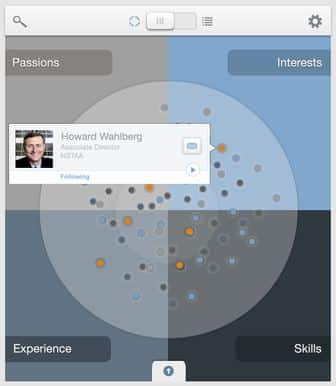
The Visual Matching EngineBuild a Profile
See the Room
AI Paralysis
Talk to Me About
Three phrases on a badge.No keyword list could hold an audience like TED's. So we added an open field: three phrases, in your own words, that you'd happily talk about with a stranger. We called it Talk to Me About, and the phrases were printed on the conference badge.
It turned out to be the best ice-breaker we ever built. It worked at events, inside global companies, and in associations and nonprofits. It outlived the software: TEDx events are still encouraged to print their own Talk to Me About lines on attendee badges.
Who Used It
Close to 300 communities, for conferences, corporations, universities, associations and nonprofits.David Nour
Relationship EconomicsA. Wigs Mendoza
Metropolitan Water District of Southern CaliforniaThree Chapters
Platform. Components. Region.The Platform
The Components
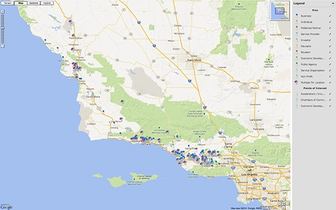
805connect
Who Built It
Mark Sylvester
CEO, Co-FounderKymberlee Weil
President, Co-FounderThe software is gone. The idea isn't. "People you should meet" is now a feature in almost every platform you use. In 2003 it was a Flash demo at a conference, built by a handful of people in eight weeks.
In 1984 I co-founded Wavefront Technologies, the Santa Barbara company whose 3D software lineage runs into Maya. That was about making geometry visible. introNetworks was about making a room full of strangers visible.
The pattern never changes.